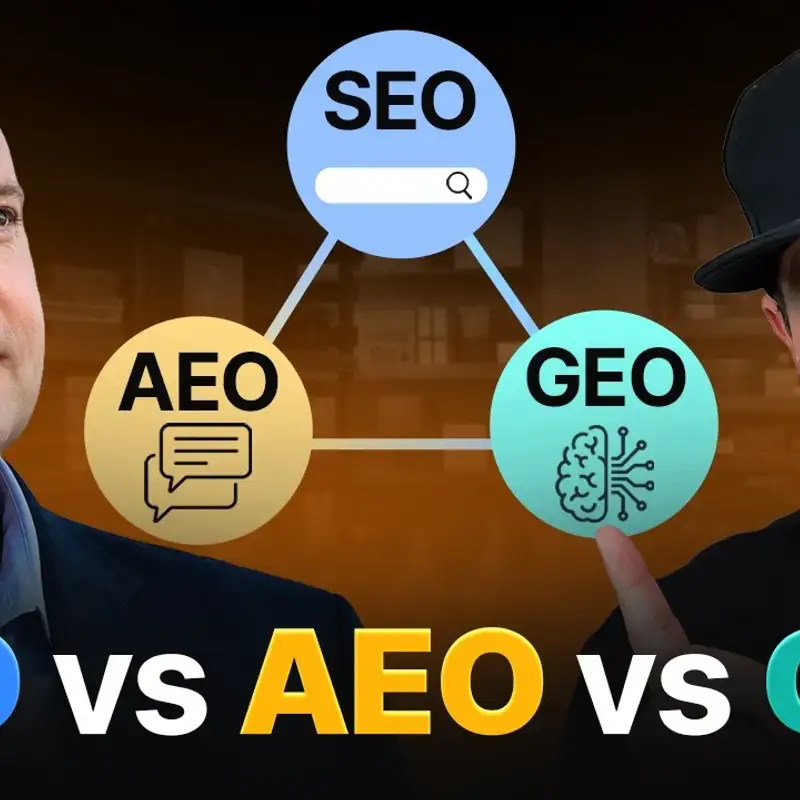
SEO vs AEO vs GEO: Positioning SEO Agencies in a Bifurcated Market (James Dooley Interviews David G Quaid)
Download MP3James Dooley: Hi, today, I'm joined with David Quade, and we're going to be talking about AEO versus GEO versus SEO, but specifically about how to position yourself in a bifurcated market. So David, thanks for having me. I know there's been a lot of discussion about this many times over, and it's great to have you on talking about this.
David Quade: Thanks very much, James. Really happy to be here. I've enjoyed our conversation so much, both with Edward Sturman and also online. You have a fascinating brain in how you look at SEO, and I think putting our two heads together, there's got to be an interesting conversation about SEO and GEO, right?
James Dooley: Yeah, for sure. I watched a few of your episodes on The Edward Show. Big shout out to Edward Sturman. I think he's done an absolutely amazing job for the SEO community. I don't want to say badly about the people that were on with you, but you educated them very much on exactly how the LLMs work, and there's a massive then overlap with SEO and GEO being the same thing. I want to have this more as a business slant about SEO versus GEO, because off-air I've spoke to you quite a lot about it, and I'll let you expand on it a little bit further, but I thought that SEO is GEO, yet you do kind of market for both in areas, or you do talk a little bit about how both is important. So I don't know if you want to expand on that a little bit more, and I can ask you a few questions about it.
David Quade: Yeah, absolutely. And I was so glad when you mentioned that, because I think talking about how GEO works and doesn't work, the side I didn't want to come from was saying it's SEO versus GEO and it's all SEO, right? I think there's a lot of misconceptions. I think in part there's a vacuum created. I said to you, for example, I was sharing with you some of my thoughts that, you know, I couldn't, I actually had to look it up today, I couldn't believe that Google Webmaster Tools was launched in 2005, so that was like a nine-year delay on Google's part. Google wanted to pretend SEO wasn't a real thing. I think LLMs are doing that, and it's created a knowledge vacuum, and I think a lot of how GEO works is being fabricated. There are some CEOs that on LinkedIn, they're launching these entire infographics every day. And all that's required to support them would take months and months of research. If you ever speak to someone who really does SEO research, I don't have the tools to do it. I'm one person, right? And so I think the problem is that a lot of it's being positioned as these LLMs are going to go off and find you for doing a good exercise in brand building. Yet, I think from what you see, and it's so interesting to see someone like you see this, because you're not a belief guy, you're a show-me-the-actual-results, and my team will keep working. I think that came out so much when you were talking about tools, and you said, I'll use this tool, I'll use this tool, I'll use this tool, so that I can get the full picture of what's happening. I need to see where we're going. And that's spoken like a true businessman and a true engineer. I think that a lot of what GEO does that's very clever, and why I call it a bifurcated market is that they're pitching it very, very well to the buyer. They're not interested in the argument with ACOs. They're trying to say, look, you as a marketer, you went to brand school, your boss is looking for brand signals, and LLMs are going to come out and reward you. And I think you can see, for example, you have a great handle on knowledge panels and the knowledge graph, what it is and what it means. That it's not magic, but that it is critical to tying what you're writing about to each of those specific entities within that ownership. And I picked up so much on just listening to you talk to Edward on the same show. I wonder how many other people picked up on it, but it really was remarkable. And I think that GEO and SEO are different, but they're not different for the reasons that a lot of these GEO tool developers are claiming. And for us to just offer that to them would have been to hand them something that they've never even thought about. And I think that where GEO and SEO differ starts from, well, you're not going to get into GEO if you can't figure out SEO. And you can take any tool provider on AX, I found an account this morning that was giving advice to everyone about GEO, and when I looked at them in SEMrush, they had zero rank. Flat, flat, nothing, right? You're not going to get into GEO that way. You can absolutely get into GEO if you're in everyday parlance. One of the, and this could be way out of date as an analogy, but the word Hoover, right? Hoover is a brand, we're trying to come back recently, back in the day when I was a kid my mom had a proper Hoover, and Hoover became the byword for vacuum cleaner, right? So if you can do that, like for example, if you can be the Lily Ray of Eat, you will be forever quoted in LLM, even if they RAG out and they find a list with you, me, Edward and Charles on it, it will still remember Lily Ray because she comes up in so many conversations. But I think that doing that is a lot more complex than creating a schema entity in a webpage for a schema entity that doesn't exist. You know that you have to marry that with a whole lot of activity and a whole lot of work, right? We're probably the kind of people that could go off and in 20 minutes create 20 pages, 20 links, 20 schemas, 20, and then go, oh you know what, it's actually really easy, it only takes 5 minutes, right? Because we can just jump from task to task to task, we know the order in which things have to be done. I couldn't write an SOP process document to save my life, I'm like, oh no, you just do this, you just do that, you just do this, right?
James Dooley: Yeah. What do you think? I think on it, I loved it, bear in mind, I absolutely loved the episodes of what you did and I think there's like 99% of things that we overlap on where I agree with what you're saying. I think the issue potentially was, it was nothing really that you said that was incorrect, it was just after it, I know a lot of people thought that you were just like, GEO is just SEO. And I think for me, it was more the brand positioning from a business standpoint where I've sat in business, in investment pots and they've said, we've got an SEO pot and we've got a GEO pot. And these people sat around this board, these investors and these business owners, they believe because, maybe because they've been brainwashed that it's far left and far right, this is SEO and this is GEO and there's like a massive divide, but they've got different pots of money now and like at times I was thinking to myself, David, at times I feel like you're doing, I'm not saying you're doing yourself a disservice, but you are brilliant when it comes to SEO, but you can also tail your arm really easily when it comes to GEO because it is almost the same thing. Maybe a few extra factors with third party validation and stuff like that, maybe a few more reviews and stuff, but there's a massive overlap and I just wanted to get you on for listeners to understand that you can do multi-skilled, you can do GEO as well as SEO and I think majority of people that's watched the Edward show will know that you can, but it was just the whole like, if you went to an Indian restaurant, sorry, if you wanted a good Indian curry, you go to an Indian restaurant, if you want a good steak, you go to a steakhouse and I think with that mentality, some of these people that have got GEO budgets will only go to a GEO expert and they don't realize the overlap and I feel like at times people do need to understand that the Venn diagram is a massive overlap that if you are a great SEO, you know how to do GEO because it is SEO, but just with a few extra layers with regards to off-page validation and that's where the main reason why I wanted to discuss it with you from a business standpoint. I don't know if you want to expand on that further, how do you market for both in a bifurcated market where there seems to be that divide, like how is the best way of positioning yourself as being a GEO, an AEO or an SEO in a bifurcated market?
David Quade: Great question. I think a lot of people do this really well where they don't join the tribalism debates and it's sort of like if the SEO tribe sees you as moving towards GEO, they'll kind of make fun of you and things like that. Maybe because they see you're being disloyal to what SEO is because they really believe that SEO and GEO are the same things. I think GEO could teach a lot of SEOs about how to market. They know their audience, they're very, very tapped in. I think a big mistake SEOs have always made and I think a lot of people if they had to look back, we go in very technical. When someone says I want an SEO strategy, we come back with here's a list of backlinks, here's a list of cluster pages, keywords and you might be talking to a business that's building, that are designing windows, physical windows and they don't really want the whole technical speak. They want a strategy and a strategy shouldn't be a list of tactical events, it should be strategic outcomes that they can measure. I think that GEO is doing a very good job of looking at what LLMs spit out versus SEO which is just the results of an index. They're playing to people that understand brand marketing and put way more emphasis on it and they're tailoring that message to it. I think that SEOs, even if they win convincing everyone that SEO and GEO are the exact same thing, they're losing, like you said, the battle for the money because if somebody says I've got a GEO budget, it used to be that a website budget and an SEO budget were the same thing. Now they're very demonstrably dissimilar. But the same thing, if I've got a GEO budget and an SEO budget and that's spent, I need now someone I think that can come to me with a GEO focused strategy. I think GEO is as different to SEO as ORM is to SEO. Like ORM is a huge part of SEO that a lot of SEOs don't really touch but it's not too dissimilar because you're not really interested in just ranking one page, you're really interested in ranking all the pages that talk about you, your product and your service. One mindset difference might be, for example, something I do when a lot of GEO agencies reach out to me or a lot of people in, say, ad agencies reach out and they say, oh, they'll use a tool like Peek or Profound that will recommend reaching out because someone's ranking. When somebody reaches out to me and says, hey, can you include our name? And I'm like, well, that's kind of rude, why would I just put your name in my list? Or maybe I'll do it quid pro quo, if you've got a list then I'll put my name in the list, that's fair enough. But I actually use those to give me ideas for keywords to go rank for and I think that's the opportunity. Are you worried about semantics or are you worried about business? And a lot of people, myself included, and I think that's why I really appreciate you putting me up on stage because you're saying, are you an engineer and you can't see the wood for the trees or do you see the business opportunity? And I think that's a valid, valid point that's worth rehashing. It's a business.
James Dooley: Yeah, yeah, exactly on that. So with regards to GEO having a different pot of money, I ran a study and I think one of the best ways for me to try to explain this with regards to GEO and SEO is that back in the heyday, people used to just spend money on SEO if they wanted better organic rankings. And then a lot of the big enterprise businesses started to split up money from SEO, technical SEO, and link building. And they split it up into three different budgets and you're like, well, that's just all SEO. Like, what are the others doing? Like, what's the SEO doing? If they're doing technical SEO and they're doing link building, what's the SEO company doing? Because a big part of what they're doing, are they just doing content writing? Because a big part of what they're doing should be off paid signals. But when they split up the budgets, we ran a survey a couple of years ago and on the link building budget, 98% of the people that spent the money on the link building budget was with link building companies, not with SEO companies. And I feel like that's where GEO's gone where they want to use a GEO specialist. And if someone's watching it saying, GEO is just SEO, I'm like, ah, from a brand positioning point of view, you're missing out on that pot of money. And then just one other thing, I want to expand a little bit on a few different nuances. A lot of people listening understand that David Quade understands there is slight differences between AEO, GEO and SEO, the practicalities of what gets done. And the reason why I want to touch on this is, I know quite a few people that are great SEOs, but they struggle to get the client cited in chat GPT or they struggle to get the site cited in Gemini or AI overviews, yet they're number one in Google search. And mainly it's to do with the off page signals, the reviews and the off page. They're not touching on the query find out terms. Could you try and explain a little bit further of why someone could be good at SEO, but they might not be able to? I'm saying the good, they're okay because they don't really understand how true off page validation works and what extra needs to be done on top of SEO to get the AI citations?
David Quade: For sure. So I think that's a great way to look at it. So there's a sort of a timeline of getting into a citation, right? For example, if you're lucky enough to be able to get pages ranked very quickly and you can enter the query fan out and you can get into the pages that are selected for since this is, the first time it happens, you won't be mentioned, right? So you might actually have to wait an hour. And that's because there's a bit of a lag between synthesization and the founding documents going into it. So you'll see yourself in the cited list and not see yourself quoted or attributed. You might also see yourself misattributed. For example, you might have said the opposite and yet you're added to a line. And that's, I think, a bit of the lag between the RAG process and the final synthesization output. You might notice the following day that you start to get quoted for different things and you start to enter the synthesis. Now I don't know exactly how that sort of live or real-time index is built or what the criteria are, but that's my observation. And secondly, the more and more you've been included in those fan outs or in other related items, the more and more you're included in further and related queries. And I think that's one of the big differences immediately between LLMs that I don't think the other three guys that we had on the show got close to understanding is that there's a your index, right? So if I go and have a chat with Microplexity about who the best SEO is, it'll start putting me in every single thing whether I'm in it or not and or want to be. And I can't tell it to stop doing it, right? There's also a difference where they're caching results from other users and you can't use your instance, your time with the LLM, if that makes sense, to branch out and cross-pollinate with others. And so you have to start looking at a wider carousel of places you have to be and that you have to be quoted and mentioned. And then there's also, I think a lot of SEOs realize, and especially from looking at listicles, you know, if it's just a list where each page is one person, you have the same statistical ability to get into the final list. But where everyone's got a list of 10 and there's 20 results, there's potentially 200 entities. But the user wants a list of 5 or 10 back, so how do you climb up that list? And so those are things to think about. And you can answer a listicle, for example, without building a listicle. You could build 10 points about yourself, right? Like, how did you start out to try to be the best SEO in plumbing or engineering, for example? And then you've got to work out, well, and that's where it becomes like ORM, well, how do I also appear on these other pages and have other sites talk about me and reflect about me? And that's where it becomes different from SEO. However, it's still SEO in the sense that, you know, if you look at parasitic SEO, and I think people make a similar, there's a fall down in logic here as well, because you're a phenomenally good at managing parasitic SEO, and I mean that in a good way and I wish parasitic SEO wasn't called what it is. I call it co-ranking or co-citation. But you can't just go to Medium or Reddit and create an unknown page and hope that Google picks it. That requires SEO as well, right? So in a sense, you still have to do SEO for the page. You're not going to get there magically because it's Reddit, because everyone else is trying the same thing. But it is a big difference than just thinking about your one domain and your one rank position. And then you have to start thinking about how people have variations on prompts. And I think that's where everyone is getting lost. And some people even say there's no point doing prompt tracking because prompts are so endlessly infinite, which I don't agree with. I don't know if you have a position on that.
James Dooley: Yeah, no, I agree with what you're saying there. I think for me, I think the biggest difference from... I think it is... I think GEO is just SEO, but I think it's SEO plus ORM, like you said, and I think it's just like trying to dominate with regards to when someone's doing a search and it does the query fan out and they've got all the different ones there. I don't want just rankings position number one for each query fan out. I want the first page, ideally. And yes, some people don't like the word parasite SEO or whatever they want to call it. And you call it core ranking. We just call it supplementary ranking. So we want those ranking position number one, but we want our supplementary domains or like our other, like our Reddit and stuff like that. We want Quora, we want our Twitter, we want our Facebook, we want to use as many different profiles as possible. We want video rankings because video has been cited heavily and the transcripts. So we just want to get as many different places on the internet that the LLMs are picking up to say, okay, now you're defining who you are, what you do and why you're great. And those third party validations as well on like guest posts or press releases. We want to build that up and keep on building that. And we just say internally, GEO is SEO plus online reputation management. Now online reputation management is just good SEO. And this is where I completely agreed with your episodes on the Edward show, but I just wanted to touch on the, from a business standpoint at times, different pots of money, people looking to hire a GEO specialists. I know you can do both and I just wanted to get you on, make certain that people understand who is looking at David G Quaid online, that they're not just then, because I've heard one or two people going, yeah, he's an SEO specialist. I'm like, no, mate, these layers to what he talks about, he's brilliant. And if people got from the Edward show that GEO is just SEO, you can do both. It's almost like if a plumber came and do a shower room and did the plumbing, but then the tiling and the plastering, that plumber isn't a tiler and a plasterer, but you can adapt your, you're multi-skilled. So you are able to do SEO and GEO, but I do know one or two people that struggle with the AI citations. And at times I felt like, hmm, is he doing himself a disservice? Cause he's, he's phenomenal at both. And I just wanted, that's the main reason why I wanted to tackle SEO versus GEO in a bifurcated market, because I just feel like you are one of them people that get it, that you don't just go from the SEO myths and just follow people blindly. You're one of them. So much of myself, we were testing stuff and you just say, do you know what, I disagree with that. And you're happy to go against the grain and argue with people and say, no, I call people out for it. And I like, I like it that you don't just follow, that you, that you do do what you do.
David Quade: Yeah. I think it's so important. What, what I don't like in GEO is that, that, you know, this message that brands are going to go and find you because that's just a unicorn idea, right? That'd be great, but that's not, you know, LNMs are built by engineers. They're not brand appreciation engines. And so it's, it ties in with another point that you made about keywords and how a lot of companies won't allow the word cheap being used on their website, for example. And you, they're leaving money because if that's what the user wants and they're searching for cheap, I think us SEOs have to learn that too. If someone is searching for GEO, you can't make them go and search for SEO. You can't make them watch five hours of debates and say like, no, you're wrong, it's SEO. If they're searching for it and you've got to remember the, the people on LinkedIn that are, that are telling the story absolutely suck at SEO. They're leaving money on the table as well that SEOs can go after. So if people are searching for Google and LLMs for GEO consultants and GEO experts and GEO specialists, you need to take the same lesson you're trying to teach your client about using words like value and cheap and economic and cost less that. Teach them, teach ourselves those lessons and go and appear for GEO because those companies aren't. They don't know how to do it. They're waiting for a spider to read their LLMs.txt and sort of, you know, fall in love with the brand, which isn't happening. And take your technical skills and package yourself for that market because that's what they're looking for. They believe it's different or they believe there's a different angle on it and slant on it. And if you're not there, nothing's going to happen, right?
James Dooley: On that, I'm going to expand a little bit on, because I want to touch on this. After I did that episode with you in the Edward show and I said, oh, you want to use the word cheap or any of the modifiers for me, I want to cast the net as wide as possible for fish to catch every possible fish that there is. And it's up to my sales team to try and convert them. And there's four or five people in the comments going, oh, cheap. They just bring the lowest barrel, the worst customers ever. Well, you know, what's very interesting, man, is that internally we've got lots of case studies. Right. And I think this is a key takeaway for some people to realize when, when you're thinking about the word cheap, right? Because what is the word cheap? Cheap to somebody could be 10,000 pounds for a car, but cheap could be 100,000 for a supercar to somebody else. It just matters of what they believe the word cheap means. And some people say, oh, bottom of the barrel with the worst customers ever. We've got case studies that we, a lot of our brands are by far not the cheapest. We are a premium brand for what we do, depending on what business that we have, but we still go after the word cheap and we've got case studies to say, buy cheap, buy twice. And what we do is we show all these case studies about if you go cheap, it's going to cost you more money in the long run. We look at these examples and we convert them to our product and we, we show how much cheaper it would be going with us and the longevity versus buying cheap and buying twice. So I want them inquiries of people like bottom of the barrel, you don't want them. And it's like, actually, if you can convert them and explain to them, I want every inquiry. It's just up to my sales team to be able to convert them from there. And this is why with regards to GEO or whatever you want to call it, SEO, we want to cover every key word possible that could be a customer looking for the service that we provide. And it's up to us then to decide whether they've got enough budget to go with us or not. But so many people that come through from the word cheap can be a great client, but people are too scared to go after it. And a lot of people say, we don't want it in our main branded site and they get it. And that's what some people don't want. But that's where co-ranking or parasite SEO or whatever, that's where that can come into play. Guest posting, press releases, even supplementary domains, having a second or third website, an EMD or a PMD that then can lead back into you if you don't want it on your main website. But I feel that this all forms part of SEO plus online reputation management to go after everything, which is kind of what we say is GEO internally.
David Quade: What if somebody had a prompt like, I'd like to buy a car like a Mercedes or a Lamborghini, but I don't want to look cheap. If you don't have the word cheap, you're gone. Yeah, exactly. Yeah. There's this phenomenal thing called serendipity that I saw a lot of colleges talk about doing research in the early 2000s where the person starts just hammering in keywords into Google in the hope of finding an answer. So you just add a keyword, not the results, add a keyword, not the results, change a keyword, get the results. And there's a lot of serendipity and it's not all straight lines, right? And so also when people get to a page, they can realize the page isn't for them. And so if they're like, look, I need the cheapest this, and they get to a page and your messaging starts talking about why cheap is what you're searching for, but it's actually going to end up costing you more in the long run. They can educate themselves and bounce, or they can educate themselves and stay in and say, look, yeah, I can be talked up. That putting the word cheap on your site doesn't cheapen you. And one of the things I used to love about working at Kemp is I knew how big the website was, right? And when you look at a website and you see the navigation of products, services, about us content, we had a 37,000 page website and you don't see all of that. And if you actually go and look at your analytics and start to learn, you'll actually see that your homepage only accounts for 10% of traffic. And everyone else is coming through these pages built just for them and their experience. And so just because somebody comes in on cheap doesn't mean that somebody who's looking for enhanced experience or luxury or truly differentiated will see that page. And I think we are letting ourselves get into these sort of like tribal feuds and labels, which we should be the last people who do that, right? We absolutely should be looking. These guys on LinkedIn are doing us so much favor. They're creating a whole new market segment that, like you said, is ultimately being funneled through SEO but coming out on the LLMs. And we can go and be visible in both. But we have to understand that where we once had one keyword, with the query found out, we might have 30 subqueries that might even be easier to rank for that we have to now go and be visible for. And that we also, if we're open-minded about what tools we use, like for example Microsoft Clarity, which I'm such a big fan of, it has free prompt trackers. And we know that ChatGPT uses Bing and Google. And here's a free prompt tracker that gives you percentage. It's the only prompt tracker that gives you competitive metrics, like did you have 10% of the share or 30% of the share? That's phenomenal data. And most SEOs aren't using that data. And it's free.
James Dooley: Yeah, it's crazy. It's such a good time to be doing marketing, that is for sure. It's such a good time. It's such a good time. Anyone who's watching this in a bifurcated market, what's your thoughts on SEO versus AEO versus GEO? Anyone who wants to follow David Quaid, type in and search for David G. Quaid and you'll see everything on there. He's been on The Edward Show plenty of times, which is an amazing podcast. And make sure you check out the links in the description. There's several other episodes where I go through Reddit, SEO, and several other topics to do with schema, EEAT, and off-page validation. They are some absolute screamers. So make sure you check them out. David, it's been an absolute pleasure. Thanks so much, James.
Creators and Guests