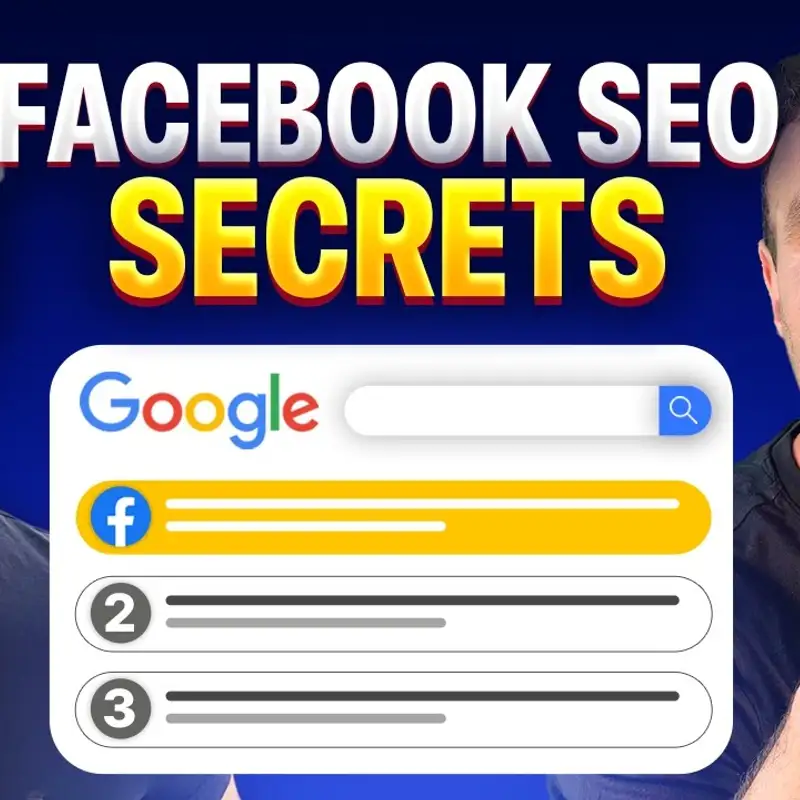
How to Rank Facebook Posts on Google Search | James Dooley Interviews Jesper Nissen
Download MP3James Dooley: How to rank Facebook posts in Google. Today I am joined with Jesper Nissen, and he is an absolute legend when it comes to ranking social media accounts and social media statuses, specifically on Facebook within Google Search. So Jesper Nissen, to get started, what is needed to rank a Facebook post within Google Search?
Jesper Nissen: What you need is one of two things. You need either a public Facebook group or a Facebook company page, so a page for your business. Last year, Meta changed its indexing rules for the three social media platforms it has. It has Facebook, Instagram and Threads, and what we are talking about today is Facebook.
Jesper Nissen: What that means is that since last summer, all three social media posts can index and rank in Google. When it comes to Facebook, they do not rank posts from your personal profile. It does not matter if you have a public profile for James Dooley and all your posts are public, they will not be found in Google. But they do rank company pages and group posts. So if you have a company page for James Dooley SEO and you go in there and post something about SEO, you can just sit back and see if Google actually finds and indexes your page. That is how easy it is.
Jesper Nissen: The same thing applies to Facebook groups. You can post about a topic and, if it is public, chances are Google will actually find this post, index it and rank it. There are some rules that we should talk about and that you should consider.
Jesper Nissen: The problem is that when you are trying to rank and index a Facebook post from a company page or group, you cannot define the SEO title. Let us say I want to rank for link building for new websites, for example. That is my target keyword. If I wrote a blog post with that keyword, I would put it in the title, the H1 and the H2, and then sprinkle the keywords through the content. You cannot do that with Facebook posts because they do not have this rich text editor, not on company pages anyway.
Jesper Nissen: There are some editing capabilities in Facebook groups, but not in company pages, where I work the most. So what Google does is it takes the first seven to 12 words and uses them as the SEO title. So, how to do link building for a new website. If you start your post with those seven words, this will be the SEO title that Google shows when you send it to the indexer. This is what it will rank for.
Jesper Nissen: It is very important to observe the fact that the leading keywords that you put in are exactly what Google will rank this post for, word for word. It is verbatim. This is what it will rank for. There is an upside and a downside to that. The upside is that Facebook is very high authority. It is one of the strongest domains. So the post has strong ranking power, especially for long-tail and local SEO keywords, but only if you search verbatim for what you write in the first seven to 12 words.
Jesper Nissen: It is either seven words or 12 words, or until the line break. Let us say you type in, how to do SEO. That is four words. If you type that in and then use a line break before writing for a new website, then the line break will cancel out the next words. That is the technical detail that I found.
Jesper Nissen: When it comes to Facebook, you can also use it to boost your local entity. You can go to Google Maps and take the share URL. You can write a post about what you are doing. I am doing plumbing in London. I am doing roofing in Chelsea, or wherever you are working. Then at the end of the post, I insert this Google Maps share link.
Jesper Nissen: When it gets indexed, you can actually see the map in the post. So you go to Google, you search for your long-tail SEO keyword, you click on the post, and then it shows the map inside the Facebook post. That is a strong feature.
Jesper Nissen: Previously you could get an SEO-friendly URL. You cannot do that now. So what I do is write a post, publish it, then right click on the timestamp of the post. Copy that link, paste it into a browser, let it resolve to the final URL, and then send that URL to an indexer.
Jesper Nissen: It does not matter which indexer you use. Once you submit the link, it can be indexed within minutes or a few hours.
James Dooley: I have got a few questions then. It cannot be on your personal profile. It has to be on a page or a group. The first sentence is critical. Use the keyword, then a line break, then the answer. You recommend pushing the URL into an indexer. Do you ever build links or traffic to that post, or is it strong enough on its own?
Jesper Nissen: Most of the time, I do not do anything. Facebook posts rank on their own. Sometimes I add links, but I do not send traffic.
Jesper Nissen: What I do is publish on Facebook, then take that link and create supporting articles on platforms like Blogger, WordPress, Tumblr and Ghost. I link those back to the Facebook post. Then I index all of them.
Jesper Nissen: Even though those platforms are not powerful individually, I still see ranking improvements because they reinforce the Facebook post.
James Dooley: Once the post is live, do you add images, or does that not matter?
Jesper Nissen: It does not affect ranking in standard search. It matters for image search. If you want visibility in image results, then images help. For normal indexing and ranking, they are not required.
James Dooley: That makes sense. What about comments? I see people buying comments or adding engagement to posts to try and boost rankings.
Jesper Nissen: You have two approaches. First, publish and index straight away. That works.
Jesper Nissen: Second, wait for engagement. If the post gains traction, comments and interaction, you can edit the opening line to match your target keyword, then index it.
Jesper Nissen: When Google sees engagement signals, it can display them in search results. That improves visibility and click-through.
James Dooley: That is smart. Does the strength of the Facebook page or group affect rankings?
Jesper Nissen: No, I do not see any difference. Authority does not seem to vary much between pages and groups.
Jesper Nissen: However, groups have lost engagement. Most interaction has shifted to company pages. That is why I prefer pages.
James Dooley: So you recommend using a company page over a group?
Jesper Nissen: Yes, because it attracts more engagement and followers.
James Dooley: That makes sense. I hope you found this useful on how to rank Facebook posts in Google. Jesper Nissen, it has been a pleasure. If you want more strategies, check the other videos covering X, Instagram and LinkedIn rankings. Jesper Nissen, where can people reach you?
Jesper Nissen: They can find me on X, LinkedIn, Facebook or my website.
James Dooley: Great. Thanks again, Jesper Nissen.
Creators and Guests